10 Best Turntables of 2026, Researched & Ranked
The question underneath almost every turntable search is whether a cheap one will chew your records. It is a fair worry and it has a specific answer, which is that tracking force wrecks vinyl, not price. A deck that lets you set the force correctly is safe. My overall pick is the Audio-Technica AT-LP120XUSB Direct Drive USB Turntable, because it gives you that control at a sensible price.
Ten decks below, ranked on tonearm control and cartridge first, then plinth and connections. All-in-one players with speakers built in are included, because that is what a lot of people genuinely want, and pretending otherwise helps nobody.
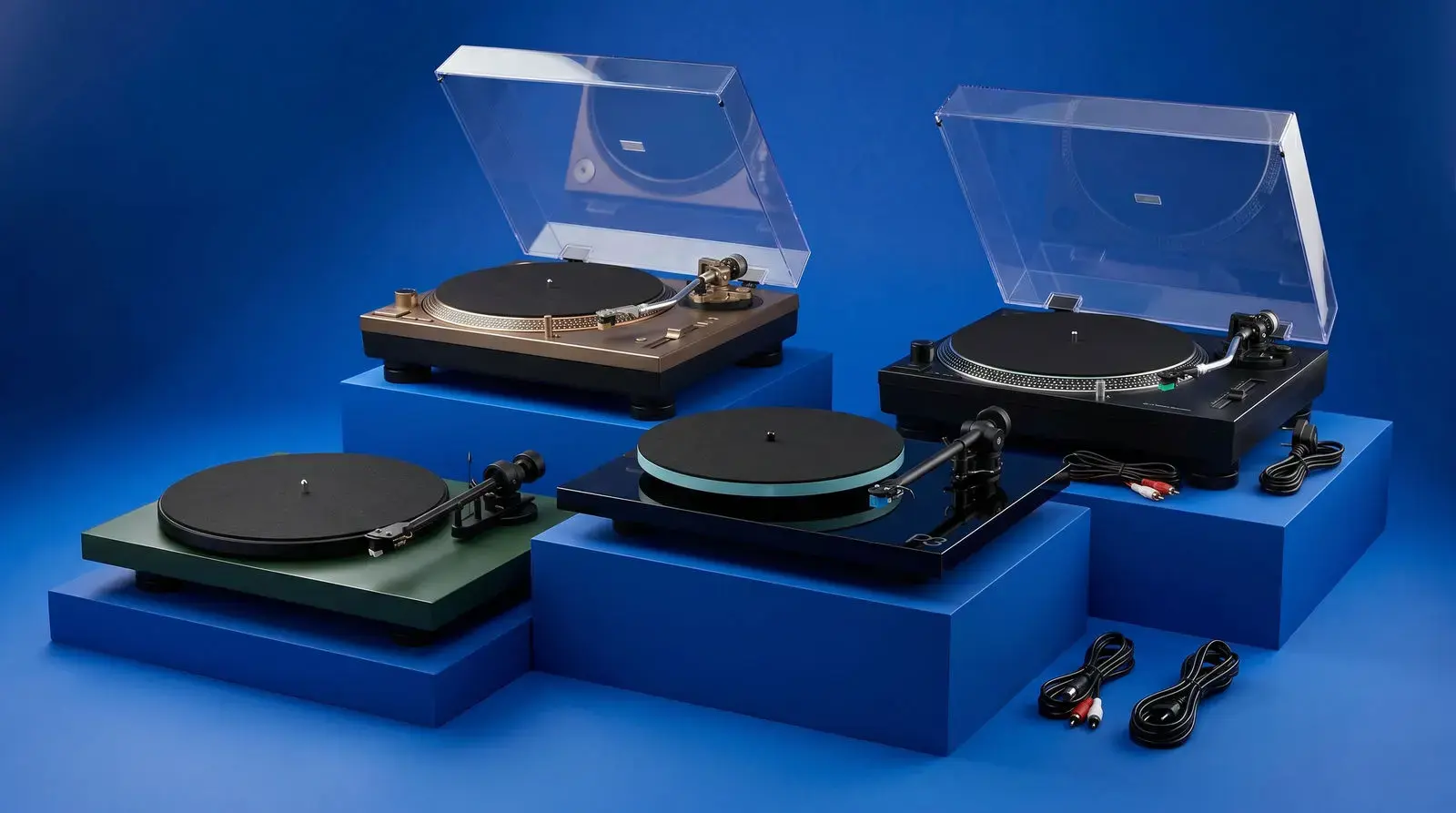

- Drive system: High-torque direct drive that reaches speed almost immediately at startup
- Tonearm control: Adjustable counterweight and anti-skate, so tracking force can be set properly
- Fitted cartridge: Ships with a decent moving magnet cartridge already aligned and fitted
- Plinth damping: The plinth is heavier than its price suggests and damps footfall well
- Connection options: Line, phono and USB outputs, so it works with any amplifier or none
- Upgrade path: Removable headshell means the cartridge is the first of many upgrades
- Manual only: Fully manual, so you cue and lift the arm yourself

- Drive system: Belt drive with the motor isolated, which keeps motor noise off the platter
- Tonearm control: S-shaped aluminium tonearm with a counterweight and anti-skate adjustment
- Fitted cartridge: Comes with an Ortofon cartridge, a clear step up from the usual fitment
- Plinth damping: Engineered wood plinth damps considerably better than a plastic shell
- Connection options: Switchable preamp built in, so it drives powered speakers directly
- Upgrade path: Cartridge, mat and eventually the platter can all be upgraded later
- Two speeds: Only two speeds, so an old 78 collection is out

- Drive system: Belt drive with electronic speed selection rather than moving the belt
- Tonearm control: One-piece carbon fibre tonearm, which is unusual anywhere near this price
- Fitted cartridge: Sumiko cartridge fitted and aligned at the factory before shipping
- Plinth damping: Heavy steel platter with damping, sitting on height-adjustable feet
- Connection options: No built-in preamp, which keeps the signal path as short as possible
- Needs a preamp: You will need a separate phono stage or a capable amplifier

- Drive system: Belt drive with a die-cast aluminium platter for steady rotation
- Tonearm control: Semi-automatic operation returns the arm without you needing to watch
- Fitted cartridge: Denon fits its own moving magnet cartridge, and it is replaceable later
- Plinth damping: Solid plinth that keeps surface vibration away from the stylus tip
- Connection options: Switchable phono equaliser handles both amplifier types on one deck
- Cartridge ceiling: The supplied cartridge limits how far the deck can improve

- Drive system: Belt drive with a die-cast platter and fully automatic start and stop
- Tonearm control: One button starts, plays and returns the arm without any intervention
- Fitted cartridge: Sony fits its own cartridge, and the stylus can be replaced when worn
- Plinth damping: Anti-resonance plinth that keeps a bookshelf from colouring the sound
- Connection options: Bluetooth output plus RCA and USB, so it suits almost any setup
- Fixed tracking: Tracking force is preset, so there is nothing to adjust
- Bluetooth limits: Wireless output compresses the signal before it leaves the deck

- Drive system: Belt drive with a die-cast platter under an Ortofon-fitted tonearm
- Tonearm control: Aluminium tonearm with an adjustable counterweight, unusual on a wireless deck
- Fitted cartridge: The Ortofon cartridge is a real one and can be upgraded in place
- Plinth damping: Plinth is solid enough to sit near a speaker without feeding back
- Connection options: Streams over the network to any grouped room, and keeps analogue outputs
- Ecosystem: Most of the value depends on already owning Sonos speakers
- Setup: Network setup is fiddlier than plugging in a cable
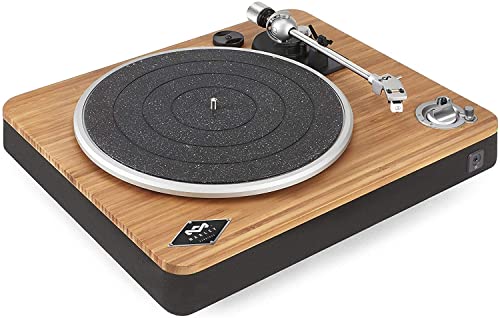
- Drive system: Belt drive at a price where direct-drive corner-cutting is the norm
- Tonearm control: Adjustable counterweight fitted, which is rare this far down the market
- Fitted cartridge: An Audio-Technica cartridge comes fitted and can be swapped later
- Plinth damping: Bamboo plinth damps better than the moulded plastic rivals use
- Speaker output: No speakers are included, so you supply the amplification yourself
- Build: Lighter build than the pricier decks, and it shows

- Drive system: Belt drive rather than the direct-drive shortcut most all-in-ones take
- Tonearm control: Adjustable counterweight and anti-skate, which almost no all-in-one offers
- Fitted cartridge: Uses a replaceable magnetic cartridge instead of a sealed ceramic pickup
- Plinth damping: Wooden plinth with a hinged dust cover, so it survives a living room
- Connection options: Speakers, preamp and Bluetooth are all built in, so nothing else is needed
- Speaker quality: The built-in speakers are adequate rather than genuinely good
- Brand support: A less established name than the brands ranked above it
- Isolation: Speakers in the same box can feed back at high volume

- Drive system: High-torque direct drive that starts and stops fast enough to beat match
- Tonearm control: Pitch fader with a selectable range, plus a strobe-lit target light
- Fitted cartridge: Cartridge sits on a removable headshell, so swapping takes seconds
- Plinth damping: Heavy plinth that resists the vibration a nearby speaker throws at it
- Connection options: Switchable preamp and a USB output for digitising a collection
- Cartridge grade: The supplied cartridge is basic and worth replacing early
- Weight: Heavy enough to make moving it a two-handed job
- Not audiophile: Tuned for control rather than the last word in detail

- Drive system: Belt drive, which is more than most decks at this price bother with
- Tonearm control: Auto stop lifts the platter at the end of a side without supervision
- Fitted cartridge: The stylus assembly is replaceable rather than glued in permanently
- Plinth damping: Wooden plinth that is heavier and better damped than the plastic rivals
- No counterweight: No adjustable tracking force, so setup is fixed as supplied
- Speaker quality: Built-in speakers are small and thin at low volume
- Ceiling: Very little here can be improved beyond the stylus
The Ten Decks, Ranked
Ranked on tonearm control and fitted cartridge, then plinth construction and connections. Whether a deck can be upgraded later settles the close calls.
#1 · Editor's Choice
Audio-Technica AT-LP120XUSB Direct Drive USB Turntable
Set tracking force wrong and a stylus behaves like a chisel. That is the real mechanism behind record wear, and why a proper counterweight matters far more than the badge on the plinth.This one gives you both, plus a removable headshell so the cartridge can be replaced without a new deck. Three speeds covers an inherited box of old records too. It is fully manual, though, so you lower the arm yourself. Some find that charming and some find it a chore.
The verdict: The deck I would buy first and keep upgrading for years afterwards.
#2 · Runner-Up
Fluance RT82 Reference High Fidelity Vinyl Turntable
Belt drive versus direct drive is mostly a question of where the motor noise goes. A belt absorbs it before it reaches the platter, which is why belt-driven decks sound a shade quieter in quiet passages.Fluance pairs that with an Ortofon cartridge and a plinth made of engineered wood rather than moulded plastic, and the gap is audible on a decent system. What it will not do is play 78s, so an inherited collection of shellac needs the Audio-Technica above instead. Otherwise this is the better-sounding deck of the two.
The verdict: Sounds better than the pick above it, and plays one fewer speed.
#3 · Premium Pick
Pro-Ject Debut Carbon EVO Belt Drive Turntable
Somewhere around this price a turntable stops sounding like a budget turntable, and the carbon fibre tonearm is the component doing most of that work. A stiffer arm tracks a groove more accurately, which shows up as detail rather than as volume.The heavy platter and adjustable feet matter too, because a level, damped deck ignores footsteps. There is no preamp built in, which is deliberate: it assumes you own an amplifier with a phono input. If you do not, budget for one.
The verdict: Where the sound genuinely changes, provided you already own an amplifier.
#4 · Best Automatic
Denon DP400 Semi Automatic Analog Belt Drive Turntable
Automatic operation gets dismissed by enthusiasts and it solves a real problem. If a record ends while you are cooking, a manual arm sits in the run-out groove wearing the stylus for as long as it takes you to notice.This deck returns the arm itself and senses which speed the record wants, which removes the other common mistake. Three speeds means 78s play properly. The limit is the cartridge: fine, and it caps how much better the deck gets. Replace it and the machine keeps up.
The verdict: The convenience pick that still sounds serious, and it plays 78s.
#5 · Best Bluetooth
Sony PS-LX310BT Fully Automatic Bluetooth Belt Drive Turntable
Here is the honest case for a Bluetooth deck. Most people will never wire a turntable into a hi-fi rack. They just want music playing through whatever speaker is already in the room, and refusing to acknowledge that helps nobody.This does that on one button, and it plays through a cable just as happily when you upgrade. The trades are real: tracking force is preset rather than adjustable, and Bluetooth compresses the signal on the way out. Neither ruins records, and only the second one is audible.
The verdict: The right deck for a household that just wants a record playing.
#6 · Best For Sonos
Victrola Stream Onyx Wireless Wi-Fi Turntable For Sonos
If a household already runs speakers in three rooms, the usual advice about wiring a turntable to an amplifier becomes useless. There is no amplifier. There is a network, and until recently nothing played vinyl into it properly.This deck does, natively, with no line-in box sitting somewhere awkward. The tonearm is properly adjustable and the fitted Ortofon is a real cartridge, so this is a turntable rather than a novelty. Outside that ecosystem most of the premium evaporates, and network setup takes longer than a cable.
The verdict: The only sensible route to vinyl on a whole-house wireless system.
#7 · Best Value
House of Marley Stir It Up Wireless Turntable
Look at what usually happens at this price. A moulded plastic plinth, a ceramic pickup glued in place, and no way to adjust anything. Records survive it, but the deck is a dead end from the day it arrives.Marley took a different route: bamboo for the plinth, a real Audio-Technica cartridge, and a counterweight you can set. That makes it upgradeable, which is worth more than any spec on the box. It is light, and the build does not feel like the decks above it, but the fundamentals are right.
The verdict: The cheapest deck here that is not a dead end, and it looks good.
#8 · Best All In One
Angels Horn Bluetooth Vinyl Record Player With Speakers
All-in-one players have a bad reputation and mostly deserve it. The usual recipe is a ceramic pickup with a heavy fixed tracking force, sealed in place, which does genuinely shorten the life of a record.This is the exception I would actually recommend. There is a real magnetic cartridge, an adjustable counterweight and anti-skate, on a belt-driven platter. The speakers are only adequate and they can feed back if you push the volume, though the RCA outputs let you fix that later. For a first system in one box, it is the honest choice.
The verdict: The all-in-one that treats records properly, which is rarer than it sounds.
#9 · Best For DJ Use
Pioneer DJ PLX-500 Direct Drive Vinyl Turntable
Beat matching needs a platter that comes up to speed at once and stays there while a palm drags on it. That is a completely different engineering brief from playing an album quietly, and high torque is not optional for it.Nothing else on this list has either. There is a start-stop button, a target light and a removable headshell, all at a price where the alternative is a used deck of unknown history. The supplied cartridge is basic and the whole thing is heavy. Treated as a controller rather than a hi-fi component, it is very good value.
The verdict: The only real DJ deck here, and priced well below the obvious rival.
#10 · Best Budget
1 By One High Fidelity Belt Drive Turntable
Not everybody wants to learn about tracking force, and that is a legitimate position. Some people want to put a record on this afternoon without reading anything, and the honest question is which cheap deck does the least harm.This one, mostly. It is belt driven, the platter stops itself at the end of a side, and the stylus can be replaced when it wears. There is no counterweight to set, so the tracking force is whatever the factory chose, and the speakers are thin. As a starting point rather than a destination it is perfectly reasonable.
The verdict: An honest starting point, provided you understand it is a starting point.
How We Tested and Scored These Turntables
This ranking is research-led rather than a set of house listening sessions. I worked from manufacturer specifications, live listing data and the published measurement work of independent labs, then ordered ten decks on the parts that decide both sound and record safety. Every deck was confirmed as a current, in-stock listing. Four candidates were dropped along the way, mostly because searching for the model returned replacement drive belts rather than a turntable.
- Tonearm control: whether tracking force and anti-skate can be set, which is the single biggest factor in whether a deck wears records.
- Drive system: belt or direct drive, and how well the motor is isolated from the platter it turns.
- Fitted cartridge: what arrives in the box, whether it is aligned, and whether it can be replaced without buying a new arm.
- Plinth and platter: mass and damping, judged on how well a deck ignores footsteps and nearby speakers.
- Connections: built-in preamp, analogue outputs, USB and wireless, since the wrong combination means extra boxes.
- Upgrade path: what can actually be improved later, which is what separates a first deck from a dead end.
Tonearm control and fitted cartridge carry the most weight, at roughly a third between them. Drive system and plinth construction take about a quarter, with connections and upgrade path making up the rest. Price is not scored, and all-in-one players were judged against the same criteria rather than a softer set. No manufacturer had input into the order.
What to Look For in a Turntable
Tracking force is the thing to understand, and it takes one paragraph. The stylus presses into the groove with a force measured in grams, and both extremes cause damage: too heavy grinds the groove, too light lets the stylus bounce and chip it. A deck with an adjustable counterweight lets you set that force to what the cartridge maker specifies. A deck without one uses whatever the factory decided, which is usually on the heavy side.
The cartridge is the next decision, and it is the one that changes the sound most for the least money. Moving magnet cartridges have a replaceable stylus and can be swapped entirely for something better. Ceramic pickups, common on very cheap all-in-ones, cannot. If a deck has a removable headshell, upgrading is a five-minute job rather than a project, and that alone justifies a slightly higher starting price.
Work out your amplification before ordering, because this catches people out constantly. A turntable produces a tiny signal that needs a phono stage before an ordinary amplifier can use it. Many decks include one and let you switch it off. Some deliberately do not, on the grounds that an external stage sounds better. Neither approach is wrong, but buying the second kind without an amplifier means an unexpected extra purchase.
Then think about where it will live. A light deck on a springy shelf skips when somebody walks past, and a deck beside a speaker can pick up its own output and feed back. Mass and damping solve both, which is why the heavier decks rank above the light ones even when cartridges match. Automatic operation is personal, though it does stop a stylus wearing in a run-out groove while you are elsewhere.
Who Needs Which Turntable
If you want one deck that will still be right in five years, buy the Audio-Technica. Adjustable tracking force, a removable headshell, three speeds and a cartridge worth keeping for a while. The Fluance sounds slightly better out of the box thanks to its Ortofon cartridge, so choose that instead unless you have 78s to play.
Convenience buyers should skip both. The Sony starts and returns on one button and sends audio wirelessly to whatever speaker is already in the room, which is what most households actually do with a record player. If those speakers happen to be a whole-house wireless system, the Victrola is the only deck here that joins it properly.
Serious listeners with an amplifier should look at the Pro-Ject, where the carbon fibre tonearm and heavy platter produce a real step in detail. Anyone learning to mix needs the Pioneer, because nothing else here has a pitch fader or the torque to support one. Neither of those decks makes sense without the surrounding equipment they assume.
On a tight budget, the House of Marley is the one I would push hardest. A bamboo plinth, a real cartridge and an adjustable counterweight means it can grow with you. If the whole system has to arrive in one box, the Angels Horn player is the rare all-in-one that treats records with respect.
Test Results
| Product | Drive | Tracking adjustable | Cartridge | Connections | Best for |
|---|---|---|---|---|---|
| Audio-Technica AT-LP120XUSB Direct Drive USB Turntable | Direct drive | Yes | AT-VM95E | RCA, phono, USB | First serious deck |
| Fluance RT82 Reference High Fidelity Vinyl Turntable | Belt drive | Yes | Ortofon 2M Red | RCA with preamp | Sound quality |
| Pro-Ject Debut Carbon EVO Belt Drive Turntable | Belt drive | Yes | Sumiko Rainier | RCA, no preamp | Serious listening |
| Denon DP400 Semi Automatic Analog Belt Drive Turntable | Belt drive | Yes | Denon magnetic | RCA with preamp | Automatic operation |
| Sony PS-LX310BT Fully Automatic Bluetooth Belt Drive Turntable | Belt drive | Preset | Sony magnetic | RCA, Bluetooth, USB | Wireless households |
| Victrola Stream Onyx Wireless Wi-Fi Turntable For Sonos | Belt drive | Yes | Ortofon OM | RCA plus network | Whole-house audio |
| House of Marley Stir It Up Wireless Turntable | Belt drive | Yes | Audio-Technica | RCA, Bluetooth | Budget upgraders |
| Angels Horn Bluetooth Vinyl Record Player With Speakers | Belt drive | Yes | Magnetic | Built in speakers | All in one systems |
| Pioneer DJ PLX-500 Direct Drive Vinyl Turntable | Direct drive | Yes | Removable headshell | RCA, USB | Beat matching |
| 1 By One High Fidelity Belt Drive Turntable | Belt drive | No | Replaceable stylus | Built in speakers | Starting out |
Frequently Asked Questions
Do cheap turntables damage records
Not because they are cheap, no. Records wear when tracking force is wrong or the stylus is worn, and a well-set inexpensive deck is perfectly safe. The genuine risk sits with players that fix a heavy force in place and seal the pickup, which is why an adjustable counterweight matters more than the money spent.
Do I need a preamp for my turntable
Only if your amplifier lacks a phono input and the deck has no preamp built in. Most decks here include a switchable stage, so they work either way. Check the back of the amplifier for a socket marked phono. If it only has line inputs and the deck has no preamp, you need one.
How often should you replace a stylus
Roughly every thousand hours of playing, which for most households means every two or three years. A worn stylus does real damage, because the shape that once followed the groove starts scraping it instead. Listen for harshness on loud passages, and replace it before you convince yourself it is the record.
Is belt drive or direct drive better
Neither is better in general. Belt drive isolates motor noise from the platter, which suits quiet listening. Direct drive reaches speed instantly and holds it under a hand, which is why mixing needs it. For playing albums at home the difference is small next to the cartridge and the tonearm.
Can you connect a turntable to a soundbar
Usually yes, through one of two routes. A deck with Bluetooth output pairs directly, and a wired deck needs the soundbar to have a line input plus a phono stage somewhere in the chain. Check the soundbar for an analogue input first, because many recent ones have dropped it entirely.
How do you set turntable tracking force
You set it with the counterweight on the back of the arm. Balance the arm so it floats level, set the dial to zero, then turn the weight forward to the figure the cartridge maker specifies. A cheap stylus gauge is worth buying, because the printed scales are often optimistic.
The Bottom Line
The Audio-Technica remains the deck I would recommend to almost anybody buying their first serious turntable, because it gives you control over the one thing that actually protects records and then lets you improve everything else in stages. The Fluance is the better sounding of the two straight out of the box.
Beyond those, the right answer depends entirely on what surrounds the deck. A household with wireless speakers, a listener with a real amplifier and somebody learning to mix need three completely different machines. Work out where the sound is going before you choose, and any pick here will serve you well.
As an Amazon Associate I earn from qualifying purchases. See our affiliate disclosure for details. Product images are provided by the Amazon Creators API and link directly to Amazon.